
Strada Sfinților, which links up with Calea Moșilor, has been described in works of literature, among them Mircea Eliade's "The Double Existence of Spiridon V. Vădastra": "Until around 1925, on Strada Sfinți…
Strada Sfinților, which links to Calea Moșilor, has been described in works of literature, among them “The Double Existence of Spiridon V. Vădastra” by Mircea Eliade: “Until around 1925 there stood on Strada Sfinților, not far from the church, a house of poor and melancholy appearance, with a patch of waste ground beside it. Across this waste ground – once enclosed by a few old planks, torn down and burnt by the neighbours in the terrible winter of 1917 – passed all those who wished to reach Calea Moșilor more quickly.” What is more, the author lived on this very street, where he is believed to have written his early works, as did Iuliu Maniu.
Anton Pann also came to the Church with Sibyls in the Mahalaua Sfinților, in the winter of 1812. Living through hard times of poverty, at just 16 he became a chorister at the Church of the Saints, or of the Sibyls, where he was noticed for his remarkable voice.
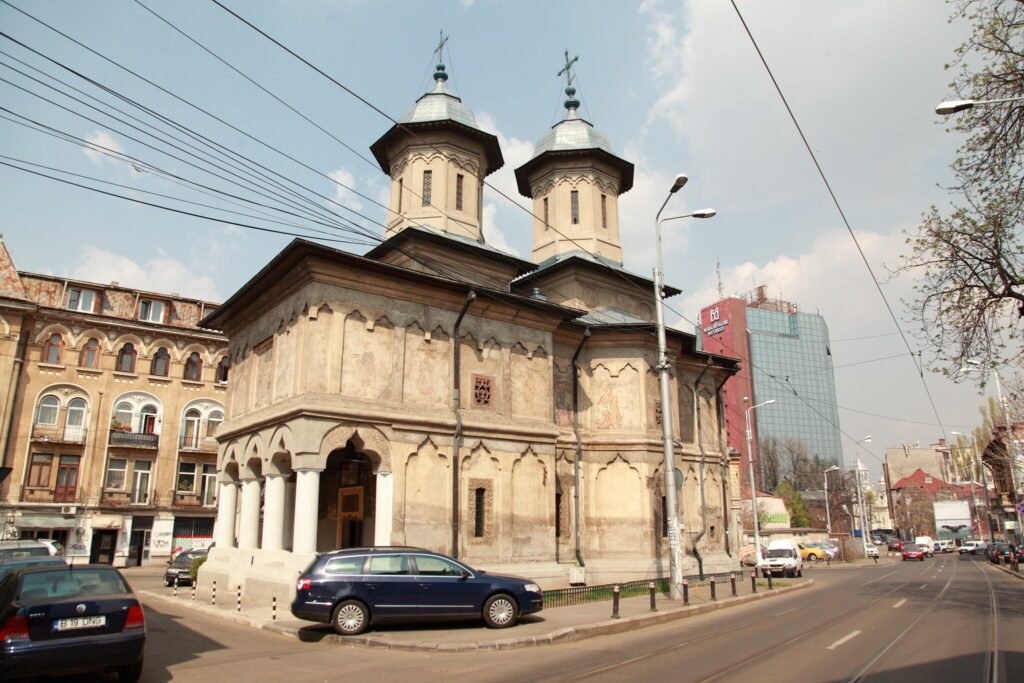
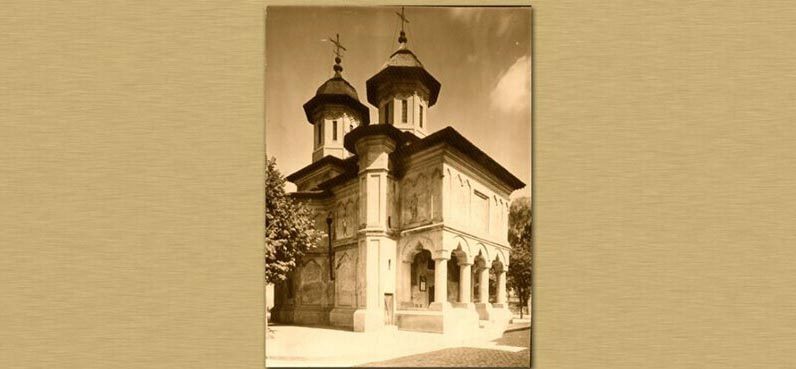
The street does not bear its name by chance: it is closely tied to the little church at its far end, known as the Church of the Sibyls, or the Church of the Saints. The first version of this place of worship, built of wood, was raised in the 17th century by Popa Hera, or Fierea, of Băjesti-Ilfov, who later became a monk under the name Filotei Monahul. Between 1689 and 1720 the church and its neighbourhood were called at times „Popa Hierea” and at times „the Church of the Sibyls”; only in the 19th century did it also become known as „the Church of the Saints”.
Rebuilt in masonry in 1828, it is unique among Romanian Orthodox churches, for its exterior was painted with images of ancient philosophers such as Aristotle and Plato. This is a recognition of the universal values of thought that Orthodoxy embraced from its very beginnings. These ancient figures are depicted according to the canons of the Eastern Church, which is why, over the centuries, ordinary people came to see the philosophers as saints and called the building „the Church of the Saints”. Yet it is also called „the Church of the Sibyls”, and here lies another artistic and symbolic detail, important and unique in the Romanian Orthodox world. The outer walls are also painted with ancient female figures, contemporaries of those philosophers, known as „sibyls”. In antiquity, the sibyls were „those through whom the gods spoke”: priestesses, prophetesses, seers and servants of the oracles of the Graeco-Roman world. They were found throughout the Mediterranean, and early Christianity knew them well. „If only for these two details of symbolic and visual representation, the church on Strada Sfinților is a historical curiosity that deserves to be highlighted,” writes historian Adrian Majuru in his work devoted to the revival of this house.
At the beginning of the 19th century, when Bucharest was first divided into administrative departments, the Sfinților quarter belonged to the city’s central district, known as the Red Colour. It lay on the north-eastern edge of the Red Colour, which within a single generation became an important financial quarter of the modern city.
The street and the Church of the Saints, just a stone’s throw from Palatul Noblesse, were part of the very identity of the area, forming a unified whole: an architectural ensemble rich in meaning.
Tell us more about your event and our team will be in touch shortly.
Request a Tailored Quote