
The beginnings of the Berkowitz business in Bucharest can be placed at roughly the same time as the first years of the reign of Prince Carol I. Somewhere between 1868 and 1872, the foundations of the House of Berkowitz were laid. We owe this dating to an official document of 7 December 1931, which mentions “the more than 60-year presence on the market of the Berkowitz Bank”. Another source places its lifespan at under 60 years. The French writer Frédéric Damé is the only one to offer a short history of the Leon Berkowitz bank, in his book Bucarest en 1906. He writes: “The L. Berkowitz Bank, run today (1906) by the brothers Elly, Adolph and Max Berkowitz as proprietors, was founded in 1880 by Leon Berkowitz the father, who at first dealt only in discount operations; however, as these operations prospered, he founded the bank and went into partnership with his sons, Elly, Max and Adolph Berkowitz, whom he led until 1903, when he retired to hand over the management to the three present partners”.
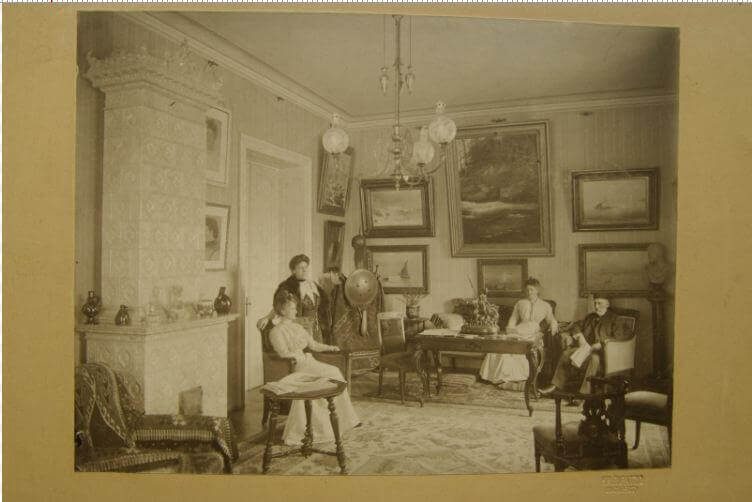
And so, from 1903 onwards, the brothers Max, Elly and Adolph Berkowitz ran the L. Berkowitz bank. 1903 is also the year in which Leon Berkowitz bought from Ioan Pascu the residence at no. 7 Strada Sfinților, which he furnished to his own taste. A most graceful and elegant retirement for an elderly banker, in a new residence far from the frenzied world of business.
Officially, however, the L. Berkowitz Bank would not be founded until much later. We learn the truth from a letter signed by the three brothers in 1931, when they applied for a “preventive composition with creditors”. It reveals that “the Leon Berkowitz bank was founded in 1926 as a joint-stock company and succeeded the old general partnership Leon Berkowitz, banker, which was wound up upon the formation of the new company. For several decades the old banking house of Leon Berkowitz ranked among the foremost enterprises of its kind, not only honouring its commitments punctually but contributing in the fullest measure both to the creation of the various credit institutions that strengthened Romania’s economic position before the war (the First World War, author’s note), and to strongly supporting the country’s trade through the most severe crises to strike the market over this long span of years” The stock market crash that began in the autumn of 1929 hit many Romanian firms hard, yet the L. Berkowitz bank was among the very few that never recovered and could not be saved, despite the measures taken by the National Bank of Romania to that end: a three-year preventive composition and a five-year grace period.
The bank’s collapse was a true disaster for the Berkowitz brothers, who, despite the years of grace, were unable to restore the family business to health. Elly Berkowitz died before 1933, and Max Berkowitz followed on 10 July 1936 – just five days before the bankruptcy was officially declared, though already knowing the outcome of the ruling. Adolf died on 25 May 1939.
Tell us more about your event and our team will be in touch shortly.
Request a Tailored Quote