

Interview – ZF Real Estate by Storia.ro: Loredana Preda, co-founder of Palatul Noblesse, discusses the complexity and high cost of restoring historic buildings, stressing that it can be two to three times more expensive than constructing a new one.
In an interview, Loredana Preda, co-founder of Palatul Noblesse, discusses the complexity and high cost of restoring historic buildings, stressing that it can be two to three times more expensive than constructing a new one. Palatul Noblesse, an eclectic building dating from 1881, required €1.5 million and more than 80 tonnes of metal for its structural consolidation, while its artistic details were restored by craftsmen using traditional techniques.
During the works, which lasted three and a half years, the team quickly put the space to use, hosting events to help fund the project. After the pandemic, the Palace began hosting weddings and christenings too, broadening its activities and becoming a landmark venue for cultural and corporate events. Future plans include developing the Noblesse Academy, an educational project offering training through art and creativity.
Read more here: ZF Real Estate – Loredana Preda.
YouTube: https://www.youtube.com/watch?v=sdhVSQ9PycU&t=1s
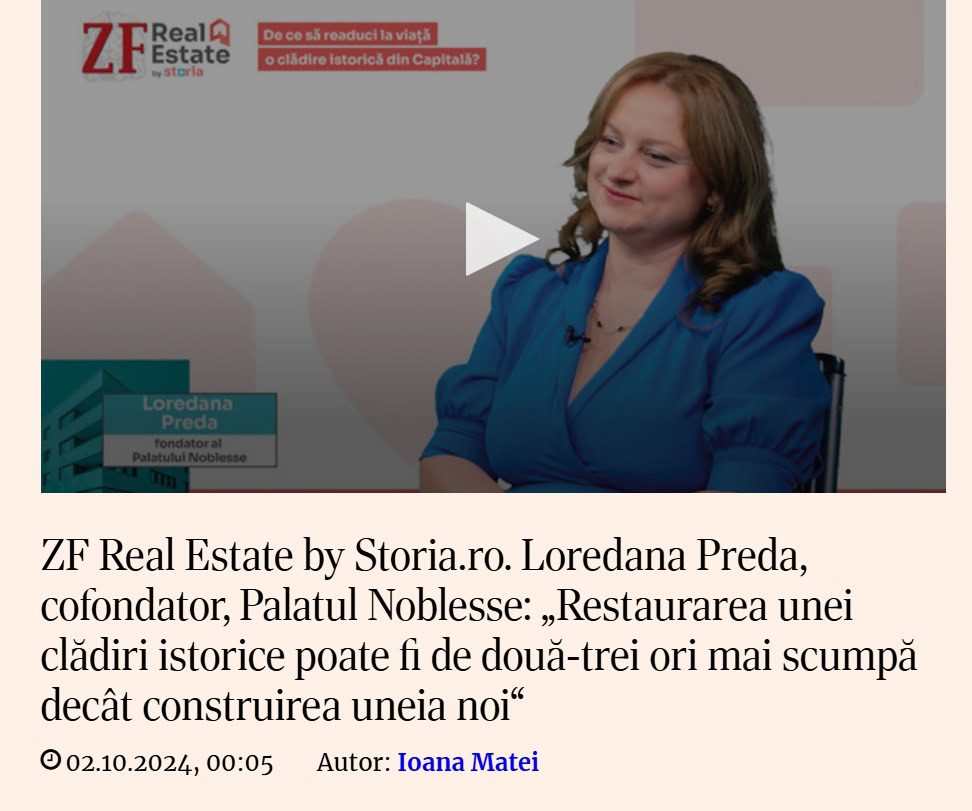
“Restoring a historic building can cost two to three times as much as constructing a new one,” said Loredana Preda, co-founder of Palatul Noblesse, in the latest edition of ZF Real Estate by Storia.ro.
She explained that the restoration of Palatul Noblesse – the first eclectic-style building in central Bucharest, dating back to 1881 – required more than 80 tonnes of metal for structural reinforcement, and that many of its artistic details, such as the stucco work and joinery, were restored by craftsmen using traditional techniques. In all, Palatul Noblesse called for an investment of €1.5 million and restoration works spanning three and a half years. Alongside the restoration, Palatul Noblesse began hosting corporate and private events, thereby helping to fund the project.
With the pandemic, the palace became a destination for weddings, christenings and civil ceremonies, rounding out its events offering. “We discovered that this segment can be just as rewarding and fulfilling,” Preda adds.
The search for such a house began in 2010, and the process took almost two years. “We visited many abandoned historic buildings in Bucharest, and the experience was as fascinating as it was moving. Bucharest has an impressive collection of buildings with authentic architecture and a rich history, yet many have been abandoned and left to ruin for various reasons – whether ownership disputes, the difficulties of structural reinforcement or the substantial investment they require,” she adds. The very first building she saw was, in fact, Palatul Noblesse, and it was the one she returned to and went on to acquire. “We bought the building from a bank after an acquisition process that lasted more than a year. We completed the purchase in December 2012, but the building was in a dreadful state – it had been abandoned for 20 years and was practically a ruin,” Preda recalls.
Although the building had fallen into disrepair, her plan was clear: to transform it into a headquarters that would reflect the values of Noblesse Group, the architecture and interior design company she leads.
“The entire restoration took almost three and a half years, with a great deal of structural reinforcement, restoration and fit-out work. We began by restoring the lower ground floor and moved our design studio there, which allowed me to be on site every day and oversee every detail. Within a year and a half we opened the ground floor and began hosting events, and in the second year we completed the first floor. The final stage was the lower ground floor, a space dedicated to the creative industries, fitted out in an industrial style, which has become a wonderfully co-creative place,” says Loredana Preda.
Alongside the structural consolidation and the restoration of original features, another challenge they faced was bringing modern technology into a historic building. “We wanted to preserve every original element of the building while also giving it a modern touch. We installed contemporary architectural lighting to bring out the stucco detailing, along with sound systems and fire safety installations, all carefully integrated so as not to detract from the house’s authentic charm.”
From a business perspective, Loredana Preda admits that the building had to start earning its keep as quickly as possible to support such a substantial investment. “We began hosting events in the very first year, because the investment needed to be sustained. In the second year we completed the first floor, and in the third the lower ground floor, where we created a co-creative space dedicated to the creative industries. In the early years, corporate events were our main source of income, but with the pandemic we also opened up to private events – weddings, christenings, civil ceremonies – and discovered that this segment can be just as rewarding and fulfilling.”
Asked about the lessons learnt over the course of the project, Loredana Preda says that one of the most important was building a passionate, committed team: “A successful team is essential. We worked with restoration artists as well as builders, and you need to know how to collaborate with all of these people to form a team that gives its very best. That was one of the greatest challenges, but also one of the greatest rewards.”
Today, Palatul Noblesse hosts corporate and private events, as well as cultural initiatives, exhibitions and artistic soirées. “It is more than a restored building; it is a cultural and creative hub that reflects our passion for interior design and art. In the future, we would like to develop the Noblesse Academy, a project focused on education through art and on personal and professional growth through creativity,” reveals Loredana Preda, looking ahead to an expansion of the Palace’s activities into education.
Tell us more about your event and our team will be in touch shortly.
Request a Tailored Quote